
Governments are known for the use of acronyms. To the point of craziness! But governments are also known for creating new phrases that have special meanings – often meaning that make little sense. Including many that don’t make a whole lot of sense. Even when they’ve been used for years.
You may be shocked to look at this map:
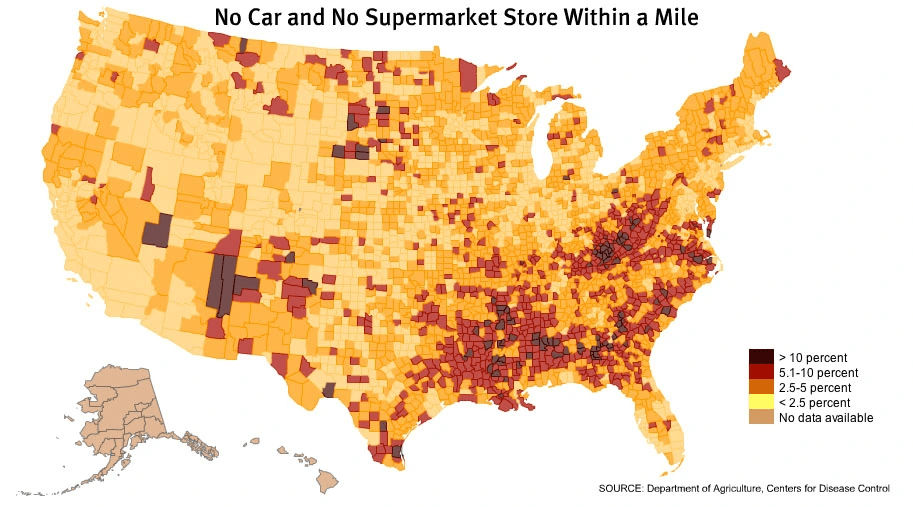
Is your town, city, or county one of the darker colors?
The United States Department of Agriculture (USDA) define a food desert as an area that has either a poverty rate greater than or equal to 20% or a median family income not exceeding 80% of the median family income in urban areas, or 80% of the statewide median family income in nonurban areas.
In order to qualify as a food desert, an area must also meet certain other criteria. In urban areas, at least 500 people or 33% of the population must live more than 1 mile from the nearest large grocery store. In rural areas, at least 500 people or 33% of the population must live more than 10 miles from the nearest large grocery store.
In other words, the government definition does not fit the usual definition of “desert.” While very quantitative, in reality it is highly subjective because it depends not on the terrain and physical elements, but on the income status of people in the area. If a community is above average in per capita or household income (based on national averages) it cannot be a “food desert” even if the nearest supermarket is 50 or 80 miles away! But a poor community can be even if the nearest supermarket is a whole mile away.
We here at TPOL know little about the Deep South, and only a bit more about Appalachia and the lower Rio Grande Valley of Texas. The Great Plain is certainly our area of knowledge, together with the Rockies from Montana down to New Mexico and Arizona. Many of these areas are tribal areas, of course: the Lakota and Navajo and Hopi, Apache, Blackfeet, and Crow. Those are many of those darker spots in the West. But we know enough to question the map and the definition. And to ask why.
Convenience stores and traditional trading posts do not count for defining food deserts. Nor does home delivery or Uber or the like.
What does this mean? That in large part “food deserts” are not just government-defined, but government-caused!
Generally, the government (state, local, and tribal) has and enforces zoning laws, licensing laws, permitting, and many other requirements that choke competition and make it extremely costly to start up and operate supermarkets. That, combined with government requirements that encourage and support mergers of supermarket chains while crushing mom-and-pop stores, has seen rural and core urban areas both lose stores and alternatives. Poor quality education both ensures that good-quality employees are hard to find and that people are less able to take basic staples and prepare nutritious foods instead of depending on pre-prepared packaged food of dubious quality. And even food producers (such as local diaries and meatpackers) are growing rare. Which drives up costs for small-town and inner-city businesses.
To say nothing of the impact of ANTIFA, BLM, Occupy, and the ever-growing mobs of homeless swarming cities. Including smaller ones.
In fact, the most recent elected-thug-in-charge of Chicago is using “food deserts” as an excuse for “government capitalism” in that pitiful city, as the Organic Prepper discusses in an article about government running food stores. Despite the “gross profits” this guy claims the supermarkets are making, the stores that they are closing are stores that constantly lose money due to shoplifting, mob looting, stupid government regulations, enormous taxes, and onerous regulations. Then, of course, government steps in to “save the day.”
More on food deserts and government-controlled food distribution and stores later.

 The Price of Liberty
I would like to see the source of the map. I look at southeast Virginia which I know fairly well, and I don’t think they take into consideration that it is very rural and sparsely populated. There are two state roads that run through the counties east to west. most of the towns are on those roads.
LikeLike
There are quite a few versions of the map, which is supposedly based on census tracts and data, and generally published either by the USDA or by US DHHS. All of the data and the assumptions used to massage the data and produce the maps don’t pass the smell test. Despite the USDA sourcing, it is clear that everything is based on misunderstandings of anything (rural or frontier especially) outside of the big massive urban areas!
LikeLiked by 1 person