
This is a technical article with a political and libertarian bent. Just warning you!
The FedGov Energy Information Administration (EIA – bureaucrats galore!) tells us: “Total U.S. electricity consumption in 2022 was about 4.05 trillion kWh, the highest amount recorded and 14 times greater than electricity use in 1950.”
4.05 trillion kWh or kWhr (kilowatt-hours) sounds about right. After all in 1950 we only had about 160 million people but now about 340 million or so today.. The average American home only used electricity for lights and maybe a radio and an iron back them. (Remember irons? radios?).
That 4.05 trillion is 4,050,000,000,000 kWhr, just to make it clear and easier to understand as we here at TPOL get older. FYI, for grins, the average cost is 23 cents/kWh. So that means that Americans paid $931.5 billion for electricity last year. That is only 1/7 of FedGov spending that year! What a bargain! Especially for something far more useful than the FedGov.
Also as a reminder: An old-fashioned light bulb with a rating of 100 watts would use 1 kWhr in 10 hours of continuous burning. An “average house” uses about 10,000 kWh a year.
Now we come to Elon Musk, who recently claimed that the entire US could be powered by a 100 mile x 100 mile square of solar power panels. Or so MSM reported. (Grain of salt, please.)
That MSM article went on to boast that the US added a “record 32 GW of new solar capacity this year, a 52% increase from 2022,” which sounds like a lot! A gigawatt is a thousand megawatts, and a megawatt (MW) is a thousand kilowatts.
Since there are 8760 hours in a year, if you have 10 100-watt bulbs shining for a year, they will use 8,760 kWh in a year, or 8.8 MWh. So if you have 10,000 of those bulbs, they will use 8.8 GWh. Now, a coal-fired or gas-fired power station can operate (theoretically) that 8,760 hours. (It actually is less than that, because you have to do maintenance but EPA orders that their potential to emit CO2 and CO and NOx and particulates must be based on 8,760 hours/year.)
But solar doesn’t produce power 24-7! It only does it when the sun is up! For sake of simplicity, that means an average of 12 hours/day, or just 4,380 hours per year (it is actually less than that, as solar systems can’t collect enough energy from the sunshine when it is early dawn or late twilight, or when there are clouds, or (in the right places) when they are covered with snow, and they too have to be maintained.
Point is, that 32 GW (32,000,000,000 watts) solar power produces 141 GWHrs of electricity. Or 141,000,000 kWHr. But we need 4,050,000,000,000 kWHr. So all this new solar is just 141/4050 of our power needs. That is a spectacular 0.3% of what the States needed in electrical power – last year. (It went up this year.) So that increased the percentage of electrical power provided by the sun for utilities from 3.1% to 3.4%. Wow! If we increase the rate new solar power is brought on-line tenfold, we would be able to power the entire Fifty States (of 2022) in about 30 years.
Except, of course, that demand would have probably tripled or quadrupled by 2053.
How long would it take to build 10,000 square miles of solar farms to power the States? How long would it take? And would it be enough by the time it is built? The website Terawatt.com tells us that a square mile can produce 425 GWHrs per year. (This website probably has the same data that Musk used.)
Even if we could design and build that 10,000 square-mile solar farm in just 10 years, power demand would likely have already doubled in that same period. And frankly, the National Environmental Protection Act process (Environmental Impact Statement and all that) would probably add at least 10 years to that. Not counting the court battles.
So maybe we should be talking about 200 x 100, or even 300 x 100, or 200 x 200: 20,000 square miles. That website advocates Nellis AFB and the Nevada Test Range (home of infamous Area 51) for a location.
No way. These people may understand solar power and electricity, but they don’t know terrain and distance. Here is a 100 x 100 mile area near Las Vegas and the Nevada Test Range:
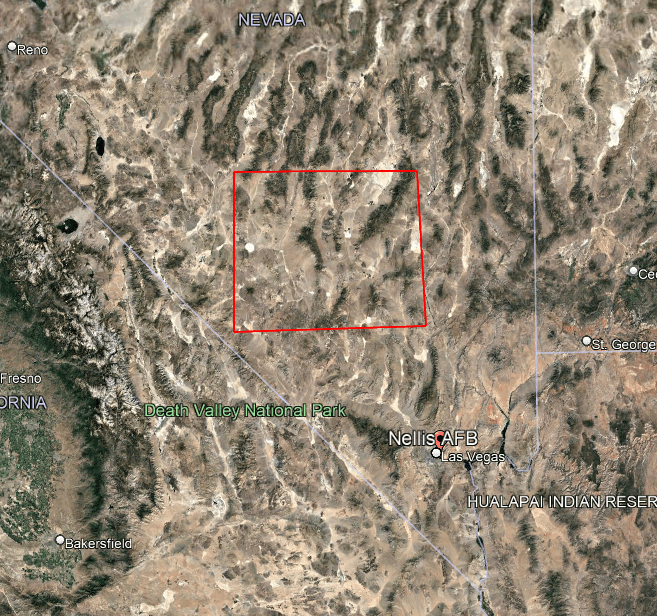
And you need pretty flat, smooth ground: steep slopes as found in mountains and canyons and arroyos of Nevada (or other southwestern US states) don’t work: you lose sun time and make construction and maintenance tough. Or you level it – you know, mountain leveling like in West Virginia? Did we mention environmental impacts? And we won’t even consider how much more power production we need to make up for transmission line losses and other factors.
It won’t work. Even Musk is unlikely to get it to work.
Fortunately, for both lovers of liberty and the idjit environists and even (maybe) the politicians, there are alternatives.
Some of them are still science fiction: a huge grid in orbit, not in a geosynchronous orbit (always over the same place on earth) but a heliosychronous orbit: always facing old Sol. Proably only ten thousand or so launches into a 600-800 mile orbit, and beam (laser?) the power down to earth to four or five dozen ground terminals.
But some are real today or in the very near future. There are, of course, various forms of small, modular, package nuclear power plants: from the Hyperion of a decade ago to very new ones. Including thorium-molten salt which are incredibly safe and cheap. And now in Texas we have supercritical carbon dioxide 10MW turbines the size of a desk. These allow for decentralized, low and dispersed environmental impacts, and local control of power.
Which is why they are evil in the eyes of enemies of liberty: no room for control. Think about it!

 The Price of Liberty
My usual complaint with ideas like Musk’s: They assume the existing centralized generation / grid distribution paradigm.
These days it is possible for many, maybe even most, people to generate their own electricity on-site.
Yes, it’s still more expensive than just having the rural electric cooperative run a wire to your home and pipe power in from a power plant (of any kind — coal, nuclear, solar, wind, whatever) 50 miles away.
But it’s getting cheaper … and your lights don’t go out just because a transformer blew down the block or a drunk driver hit a pole 20 miles away, or (and this has happened in other countries) the government decides to black your area out due to insufficiently enthusiastic obedience by the local citizenry.
Musk, of all people, should be an advocate for people freeing themselves from grids. He sells them the stuff to do exactly that.
LikeLike
Excellent points, Tom! We are in full agreement.
It is interesting to note that as tools, materials, and equipment becomes available more and more, and as costs of labor and materials for typical grid power climb, the difference between having the Rural Electric Coop run that line out and provide service and going off-grid is getting smaller and smaller. As part of our projects, we have to look at the cost of providing power, and three-phase 220v lines can run $20,000 a mile in the Great Plains and twice that in the mountains. You can do a lot of off-grid power for $20-$30K!
LikeLike
Yes, you can! I’m glad the cost equation is narrowing, but mainly I’m big into the idea of my power not being out for a week every time a hurricane comes through and tears stuff up. Or if MY power is out because it tore up my home installation, my neighbor isn’t necessarily out too.
LikeLike
Just two of the many advantages that a truly decentralized power supply offers. At least in frontier, rural, and even many suburban communities. And as Carl Bussjager pointed out decades ago, it does not take a nuclear explosion to produce an EMP that can take down the electrical grid. Combined with hurricanes and tsumamis in many areas, tornadoes and blizzards and floods in even more areas, and merely everyday things like semi accidents taking down powerlines? Much, much fun.
LikeLike