
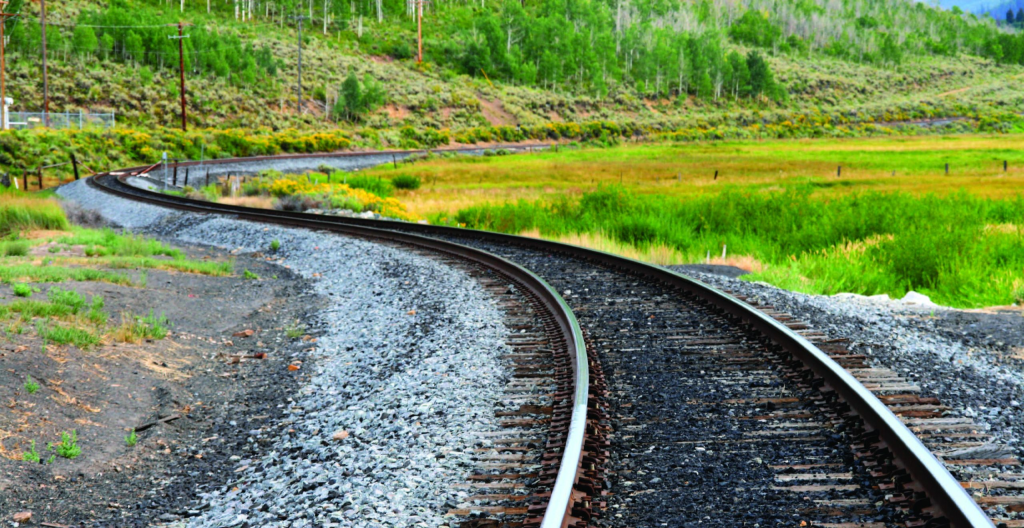
The building of the United States into a superpower, as well as a confederation stretching from Atlantic to Pacific, was the result of many actions and factors. Perhaps one of the greatest was the construction of several transcontinental railroads, starting with the Union Pacific/Central Pacific completed in 1869, at Promontory Point, Utah. Railroads continue a vital role in the American economy.
Now in Utah, the US Forest Service (USFS) had been pressured into revoking a permit to build a new railroad which everyone agrees would help Utah and all the States in many ways. Including economic, environmental, and safety improvements.
As reported here, the proposed railroad is condemned as being dangerous and detrimental to the environment (including the Colorado River), the local AmerInd nation (the Northern or Unita-Ouray Ute Tribe), and – get this – residents of the Gulf Coast. (That is the Gulf of Mexico, as in the Louisiana and Texas coasts.) The 88-mile-long railroad would go through 12 miles of presently “roadless” US National Forest System lands.
The excuses, which a Federal judge accepted, and which caused the USFS to withdraw the permit, are both many and ridiculous.
We can point out that TPOL staff is somewhat familiar with the area, having driven through and worked on projects in the Unita Basin of Northeastern Utah for many years. Including recent years, traveling to and from meetings at Price, Utah, where the proposed railroad would link up with existing railroads connecting Utah’s Wasatch Front and Colorado. Indeed, we have traveled the dangerous (narrow, winding, snow-impacted) highway that oil tanker trucks now travel dozens of times a day – often stuck behind semi-tractor/trailers hauling 6,000 gallons of crude oil as they negotiated the curves and climbs.
Much of the oil is produced from Ute lands – and the Tribe receives royalties for that oil. (When the FedGov (BIA) doesn’t steal it.) The oil is very important to the tribal and area economy, which is stunted by the cost of shipping its product: no pipelines or railroads: two-lane highways only.
The existing railroad (owned by the Union Pacific and operated by the Utah Railway) already hauls thousands of oil tanker cars and other chemical tanker cars each year, and the railroad is built along the Colorado River and its tributaries, including the Green River, for hundreds of miles. As a result it has an incredible emergency response system and a very good track record for not spilling oil and other chemicals into the river. (Indeed, one of the TPOL staff was trained on dealing with oil spills on the Colorado River using boats and booms, several years ago, as part of military duty.)
However, much of the oil from the Uinta Basin would travel north and west to refineries in the Wasatch Front (in/around Salt Lake City) and not to the Gulf States. So that oil would not come close to the Colorado River itself but only the Green River.
The people of the Gulf Coast live in an economy built on energy – especially the processing of oil and natural gas – and thrive as a result. This “protection” jeopardizes their very livelihoods.
Now, a pipeline would be the safest, cheapest, and most environmentally benign way of hauling the oil (and also natural gas). But the last decade’s record is also very much evidence that trying to do that is futile in today’s political climate. The defeat and destruction of pipeline projects in the Northern Plains and elsewhere – generally with the active participation of AmerInd tribal nations – has cost tens of billions of dollars.
Of course, one of the primary reasons that so many oppose this is that the project sustains the oil and gas industry and supports American energy independence. Coal is dying, courtesy of the worship of manmade global warming/climate change. Particularly by Uncle Joe’s regime. But that is not enough: we must also destroy oil and gas and the entire industry because it (among other sins) supports the States’ energy independence.
Clearly, if it is wrong to build railroads in the 2020s, it was wrong to build them at any time in history. According to the environists and anti-fascists and those who are enemies of liberty, we must learn from our history and correct it. At least that seems to be the gist of their crazy arguments.

 The Price of Liberty
It would be interesting to have a time machine and be able to find out how the western US would have developed absent the massive corporate welfare / military invasion combo which powered the expansion as it actually happened.
I suppose a utilitarian case might be made that murdering natives, stealing land, and shoveling piles of money at corporations produced a “better” result in that particular case than not doing so would have. But that would hardly make a moral case for continuing/extending the two latter policies.
LikeLike
Tom, you raise very good questions and points. But we must be careful not to over-simplify the situation in the 1800s. Yes, there were large numbers of AmerInds murdered in the States which the UP (and other RRs) crossed. And yes, some of those were murdered by white folks. And some, even more shamefully, by US soldiers. But two things: many of the AmerInd were killed in self-defense after the killed person attacked his killer or someone of his killer’s family or community. So not murder. But a lot who were outright murdered were murdered by other AmerInd. And many of those killed by whites – soldiers or civilians – were killed in wars. Yes, wars of conquest, and that can be seen as stealing land. It is worth noting that often the land taken by conquest by whites – and by the FedGov – had previously been stolen from other AmerInd people and bands and tribes/nations. Sometiimes more than once. It is also worth noting that many of the tribes whose “lands” were crossed by the railroads did not actually claim “ownership” of the land – just the power to exploit it. And fought for that power constantly with their enemies: mostly other tribes. At least for the UP and CP, those tracks were not built across areas inhabited by farming peoples who DID claim ownership: nations like the various Pueblos and the Arikara and Mandan, for example.
Not condoning that – just explaining it. Not even justifying it. Just making it clear.
Ditto on the “shoveling government money” which is absolutely correct. It wasn’t just government money that Honest Abe shoveled at his railroad buddies, it was a lot of “government land” as well. At least to the UP, the CP, and the Southern Pacific. (One transcontinental railroad, James J Hill’s Great Northern Railway across ND, MT and on west, did not get free “government land” – don’t know if they got subsidized in other ways.)
As to better? L. Neil addressed that, to some degree, in his Probability Broach: His western North America was based on the idea of no FedGov and fewer wars and less fighting. But still even more massive assimilation. You may recall that his primary hero, William Bear, was a full-blooded Ute (don’t think he identified which band of Ute) and as I recall was astonished that there were no tribal governments in the alternate timeline he fell into. But the West was even more privately owned than our own. Perhaps more slowly transitioned from a “commons” condition to a land ownership system, and probably with fewer premature deaths by violence.
But back to reality. To the evils of murder, stealing, and government theft-and-bribery, we can add slavery: they did not call the condition of Irish tracklayers working from the east and Chinese tracklayers working from the west as slavery: but it was mighty close. And made possible by Honest Abe, “freeing” slaves and enslaving free men. (And AmerInd.) Of course, many of the tribes practiced slavery, too. And not just in Oklahoma with black slaves.
My own great-great-grandfather was a half-breed. Yes, I know that is a dirty word nowadays. But that is what he was called: half Anglo-Texian and a quarter-Comanche (Numu) and a quarter Chiricahua (Apache- Inde). Why? Well, my 3-greats-grandfather’s first wife was killed in a Comanche raid on his farm in North Texas: land which I understand was part of a Spanish or Mexican landgrant but which had also been bought from a local AmerInd tribe – probably a band of Caddoan-speaking Kitikiti’sh (Wichita) but nobody knows for sure. His second wife, from whom I’m descended, was actually a half-breed herself: half Comanche and half Chiricahua. And, I add, the daughter of a slave. A Chiricahua slave captured and enslaved in a war by the Comanche against the Apache, driving most of the Apache off the Plains and into the desolation of the Southwestern Mountains. She was enslaved by (and married to) a Comanche man of the Quahadi Band. She assimilated to white (well, Texan) society and culture. Her son, my great-great-grandfather, rejected enrollment in the Comanche Tribe in Oklahoma (still Indian Territory at the time) because he would have had to give up his farm and store in Texas. Said it wasn’t worth it for just another 160 acres and a government boarding school for his kids and a free beef now and then. We bless him for his wisdom.
The history behind this family background? In the 1500s the Comanche were just another band of Eastern Shoshone living in and around the Black Hills, dirt poor and barely making it. But they heard about horses down in New Mexico that the Spanish had bought. And they went south to steal them. And discovered that horses are really, really neat! And that eastern New Mexico and west Texas are a lot better places to live than Wyoming and South Dakota. They were a bunch of nasty, greedy and immoral people who drove out the other tribes that had been there in the south. Stealing their land to create what some have called the Empire of the Summer Moon. They found out that life was easier by raiding and stealing from people like the Pueblo and the remaining Apache and the other tribes in Texas and New Mexico. And Old Mexico, where one of the tribes was both wealthy and weak: we call them Mexicans. The Comanche raided far and wide, as far as the Gulf Coast in southeast Texas at times, and deep into the Mexican States. They attacked and killed and stole and enslaved regardless of race or creed or color.
In fact, another relative on two sides of my family was just such a slave of the Comanche: her name was Cynthia Ann Parker (family on my mother’s side). She was captured and enslaved and married to Peta Nocona, and fully assimilated into the tribe. Her son was Quanah Parker, the last war chief and leader of the Comanche. She was recaptured by Texans and in essence again basically enslaved, together with Quanah’s little sister and died brokenhearted. Oh yes, the usual histories say she was “adopted” into the tribe, but she was a slave. (So even though I have not a single drop of black/African blood (to my knowledge), I am a descendent of a slave. Reparations, anyone?)
That is why I caution against over-simplification: the world is complex and we have to accept that our ancestors, both by blood and by culture, did a lot of really bad, evil things. But their accomplishments are still great.
LikeLike
Lots of interesting stuff there. Thanks for sharing a fascinating family history.
I didn’t mean to imply that any and all blood-soakedness was attributable to “whites” versus none for “Amerinds.” I’ve learned over time to not romanticize the latter; people of all skin colors, religious beliefs, tribal affiliations, etc. seem to find ways to be evil. Haven’t run into an exception yet.
But as for land theft, I do think that bears some exploration.
Let’s take a hypothetical piece of land on the westward railroad routes.
Let’s assume that piece of land was not owned, in the Lockean sense, by any native tribe member. Labor wasn’t mixed with it to establish ownership by farming, building permanent dwellings, etc. At most it was occasionally crossed in pursuit of game, etc., and possibly fought over for exclusivity for those purposes between tribes (not individual owners).
It was unowned, unhomesteaded land. Then the US government pretended to own it, and awarded it to railroad companies. And of course those companies DID mix labor with it to put the railroads on. But the US government didn’t just award the track right-of-way. It awarded a good deal of land on either side OF that right-of-way to the railroad companies, and not for actual homesteading use, but simply as a land monopoly to extract rents for ACTUAL homesteading — towns, stores, farms, etc.
If you wanted to farm in that area, or sell to farmers in that area, or buy from farmers in that area, you needed to be close to the new railroad … and the US government ensured that everything you did to accomplish that was at the railroad’s price and on the railroad’s terms. With all other railroads excluded from just setting up competing lines nearby, of course.
Am I glad that the westward expansion happened? Absolutely. My people came from western Virginia and eastern Tennessee to Missouri in the late 19th century, and some of them ended up pushing on at least as far as Oregon, presumably by locomotive rather than by wagon train. A LOT of good things came out of the westward push.
But I do wonder how that push might have looked absent the death grip of the railroad companies on government funding, land monopolies, etc.
Maybe relations with the natives wouldn’t have gone as downhill as fast, and maybe even amicable arrangements would have been reached between “settlers” and natives instead of the horror show that follows down to this very day with the reservations, etc.
Maybe farming would have ended up being done at the most logical places for farming instead of around the most profitable places for the railroad companies (see, for example, the San Fernando Valley ag explosion after the Southern Pacific arrived then went to war with the Santa Fe over those routes — probably partially explains why half the water in the west gets handed over to that particular place for farming today instead of being available south and east).
It’s all maybes. No telling what would have happened without that massive government intervention to make a few guys very wealthy courtesy of Uncle Sugar. But it’s nice to think about.
LikeLike
Most definitely very nice to think about. Tom, thanks for a great summary; you are exactly right. There are scattered examples of doing thing the right way – without aggression including theft. The FedGov, pretending to be a neutral third party and referee, instead constantly tilted the playing field in favor of its own power and for the benefit of those whom it favored – and owed favors. I appreciate the lesson and your own family history.
If we do not learn from the past, we are likely to learn very little at all.
LikeLike