
As some readers know, The Price of Liberty’s publishers and staff are also part of several other entities and enterprises. One of those is involved in the practice of engineering in various fields.
So we get a chuckle out of tee-shirts and posters like this one:
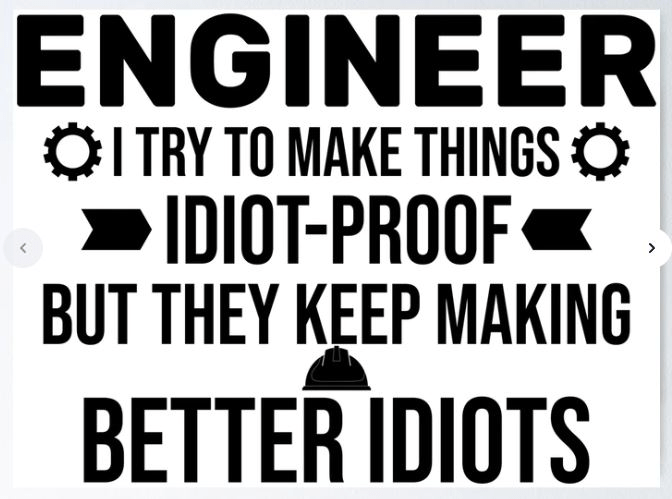
Though we hasten to point out that sometimes the idiots are engineers themselves. The statement above is an indication that we are deluded if we think that we can solve problems once and for all. And that “this time” we did it right. Thus, it is a never-ending struggle and takes place on multiple fronts. Idiotic engineers do not make things better. Indeed, they can make things worse. And often do.
Politicians, too, seem to take a somewhat similar approach: they think that “this time” the laws they pass will be idiot-proof. Not realizing that they are looking into a mirror. Too many political activists and revolutionaries ascribe to the same delusion. Although we like to point to communists and socialists who tell us with great fervor, “we’ll do it right, this time,” it applies to every type of government that humans come up with.
As with engineers, politicians must take it as a universal law that there will always be a better brand of idiot on the market. Next week, next month, next years.
At the same time, there are some differences between engineering and governing (or making laws). At least good engineers. First, good engineers solve problems by breaking them down into smaller elements and solving all the little problems, one at a time. Politicians, it seems, try to lump every problem into one big Gordian knot, and then (like Alexander was reputed to have done), slice them all up at once. (With just a little bit of tinkering, of course.) The results? Almost always failure. And also an incredible number of “unintended consequences.” Secondly, good engineers admit that they are human, fallible, and don’t get things right (a lot, believe us!). Whereas, politicians generally tend to think that they are near-perfect and mystically endowed with abilities beyond normal mortals by dint of being elected to office. Third, engineers (usually) recognize that politics, votes, and emotion cannot change natural law. Physics, chemistry, mechanics of materials, and other related matters are not decided by either popular vote or consensus.
Politics and government DO have an oversized and almost always detrimental impact on engineering. Generally, by dictating that certain things must be done, whether they make engineering (and scientific) sense at all. Often, prohibiting the most sound way to solve an engineering problem.
Of course, the prerequisites for politicians and engineers are very different. Engineers must not only be willing and able to learn what is right and wrong (at least physically) but must also employ logic and actually be able to do math on a regular basis and get the right answers! Politicians are actually less successful if they actually do math, or so it seems to us. And even if the politicians get the wrong answers (to math or any other problems), that usually doesn’t mean they get fired. Or even that they don’t get reelected at the end of their terms.
Clearly, we think that engineers are better for society than politicians. But a warning is in order: do not think that engineers are better than politicians at running society, running government, or anything like that. A few engineers have become successful politicians, and they (frankly) stank even worse than most other professions. (Well, except maybe attorneys.) We cite two examples: Herbert Hoover and Jimmy Carter.
Which is why we need to do without human government and rulers. Nobody in power seems to do a good job of running government that actually protects people and our liberty.

 The Price of Liberty