
Have you, dear reader, seen this or something similar to it?
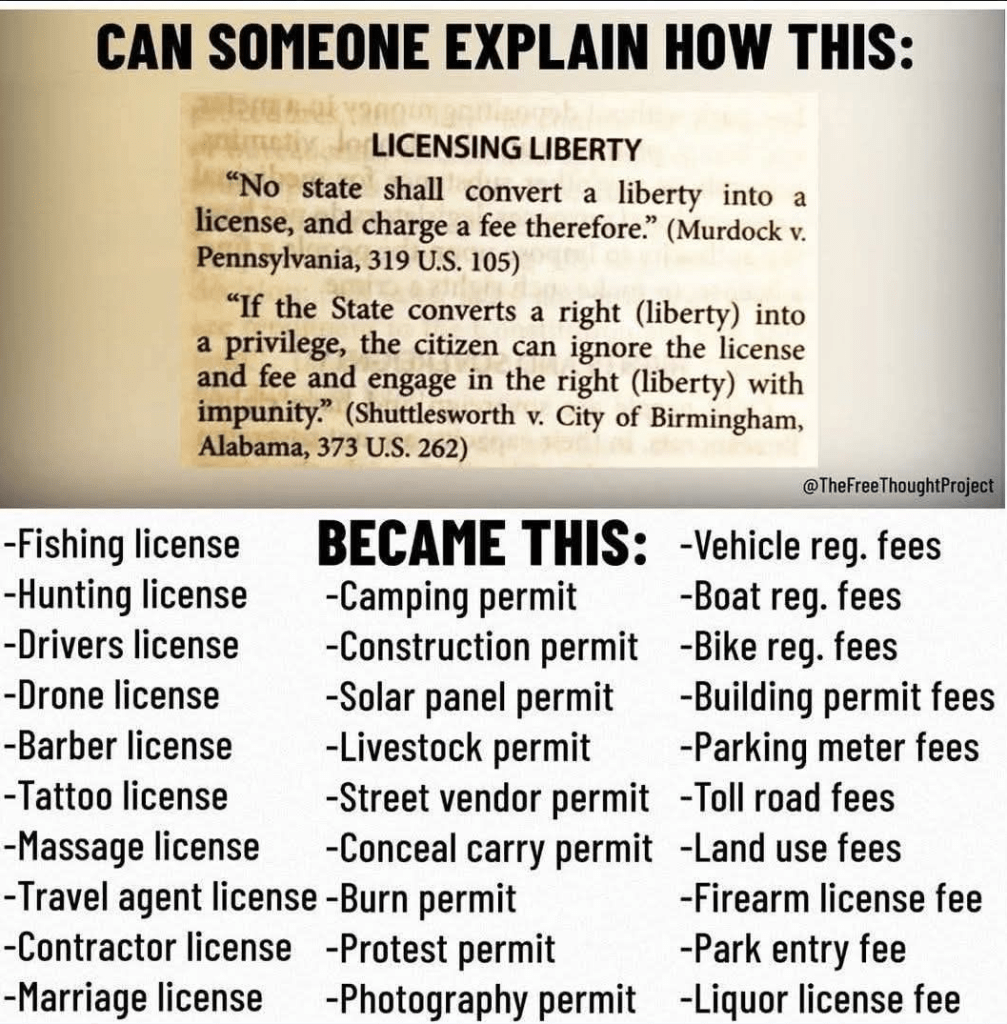
Yes, these are real cases. You can find the details online, just as we at TPOL did.
But …
Murdock v. Pennsylvania was argued 10-11 March 1943 (middle of WW2) and decided by the court on 3 May 1943. The summary, though, is a bit misleading, as showing on Justia.com. Yes, the “primary holding” is “It is unconstitutional for a state to tax people selling religious merchandise.” But it states a foundational principle, as expressed in the quote above: if we have (given by God and guaranteed by the constitution (State or federal), no government agency can require that a license is necessary to do that and charge a tax (fee) for obtaining that license.
The Shuttleworth v. City of Bermingham dates from just before the beginning of the Southeast Asian (Vietnamese) War. The case was argued 6-7 November 1962 and decided by the court on 20 May 1963. Again we look to Justia.com for information. However, here the poster above does not seem to accurately state the decision, which had to do with a conviction by a municipality of two preachers for “inciting” ten students to stage a sit-down protest, thus inciting them to violate an ordinance (by trespassing). But the students’ conviction for trespassing was overturned: they did not violate an ordinance but committed an “innocent act.” So the preachers could not be guilty of inciting others to violate the law! And their conviction was therefore set aside by the US Supreme Court.
Nowhere in that decision as posted online at the Library of Congress do we find the language supposedly quoted in the poster. Or in many places on the web and even some on petitions submitted to various courts, including the US Supreme Court. So far, we have not been able to find any SCOTUS decision which includes the phrasing in the poster above.
So we conclude that half the argument is bogus. Indeed, probably made up out of whole cloth.
Too bad.
But what about the Murdock case? Here the situation is very clear: the right violated was clearly expressed as a constitutionally protected liberty: freedom of religion. That borough of Pennsylvania was charging a fee (tax) for exercising an enumerated right (Article 1 of the Bill of Rights).
All those fees listed in the poster are not based on enumerated rights as stated in the US Constitution (or State constitutions). Now, the 9th Amendment should be considered. But here we have run into big problems. The 9th Amendment is not claimed or cited very often. In fact, it appears that the 9th Amendment has been considered in very many cases at all. As of 1973 and a Denver Law Review survey, at least, only three significant cases were decided on the basis of the 9th Amendment. And they are, as things go, really minor: the right to privacy, first in marriages (regarding contraception) and then in a “right” to abort an unborn child (the infamous Roe v. Wade, now overturned). And a 1947 case (US Public Workers v. Mitchell) stated that the 9th and 10th Amendments do not limit federal power where it is otherwise granted by the Constitution (and apparently do not limit State’s powers at all). This, according to some, is interpreted as “limiting the 9th Amendment’s use for expanding rights beyond those granted by the government.”
Is this all silliness and nitpicking? Perhaps it is. For this assumes that human governments will abide by (and can be forced to abide by) their own constitutions and are willing to defend natural (God-given) rights. History shows this is not just foolish, but indeed silly.
But the point of today’s commentary is this: if wishes were horses, beggars would ride. At some point, apparently somebody invented an imaginary citation regarding taxes, fees, and natural rights and liberties. And since then, many people have swallowed that whole, repeating it and even seeking to get the courts to accept this fake decision.
So they spread things around, like this poster, and damage their own veracity and make themselves look foolish. And therefore damage the cause of liberty.
We originally thought this would be something valuable to share: but we here at TPOL try to dig deeply enough to find what is true. For “you shall know the truth, and the truth shall make you free.” So what we are sharing is valuable, just not what we were expecting. The Murdock case does appear to be truly presented and is valuable, but may not lead to the same results as the preparing of this poster and many others online have hoped.
If anyone can provide more information and correct us on this, please do.

 The Price of Liberty