
Are government agencies and politicians at least destroying private property rights in the States? Are the courts helping them to do this, or acting to prevent that destruction? Is there even a God-given right to private property? Is private property protected by the Constitution?
These and many other questions are being asked today, perhaps more than ever. But they have always been an important facet of human society and how far governments do and should go, vis-a-vis private citizens and their activities.
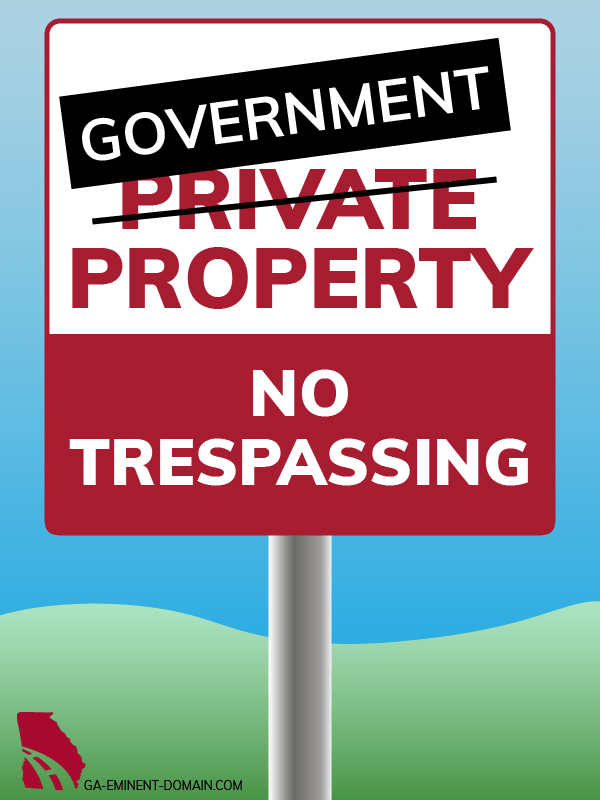

A recent Washington Examiner news story proclaims that the current SCOTUS is slapping down local governments that trample property rights.
This is an important decision and partially rolls back the frankly evil decision SCOTUS made in 2005 in the Kelo vs. City of New London decision, which significantly weakened the prohibition of governments seizing land (real property) by allowing “public purposes” in such a broad way that the gates were not just open but taken off their hinges. In the nearly two decades since then, this has indeed proved to be the case in States which did not reinforce their own laws.
But now, another abuse of local government has been at least partially controlled. Or least potentially can be controlled. Property seized for property taxes can no longer be sold and let the local government (municipality or county) keep the full amount for which the property was sold. Especially when far greater than the amount of taxes owed. The case involved $15,000 in back taxes, a property which sold for $40,000, and the government kept the full $40,000. This was an unconstitutional taking: even more outrageous theft by government than usual.
Of course, given the cost of lawyers and courts today, the case probably cost the man far more than the $25,000 stolen.
But the main disagreement with the Nine Nazgul – and with government – is that people are still at the mercy of government all too often: to eminent domain and theft of property. (TPOL strongly believes that even if exercising eminent domain – that is, forcing someone to give up property involuntarily – with honest payment of market value – is still aggression and theft. No matter what the legal definition of theft is. Persuasion is one thing: convincing someone to provide something for the public good. Stealing from them “for the public good” is wrong.
But as far as property rights in general, consider these things.
First off, consider a point made in the referenced article above: “However, despite the clear importance of property and taxpayer rights at the time of the founding, the Supreme Court has often searched for new, unenumerated rights while ignoring fundamental ones that appear in the text of the Constitution itself.” How true! The court system could find a “right to not be offended” but not the clearly stated right to keep and bear arms?
Second, much of what local governments do today – are allowed to do by the courts and State governments – are theoretically decided by elected officials. Even though it is often in direct contrast to what many people in their jurisdiction wants done. And because elected (and unelected) officials are often corrupt, power-hungry, and “know better.” Decisions like this one help a little bit, but go nowhere near as far as is needed.
Several examples of this problem are seen in some cases we here at TPOL are very familiar with.
Several years ago, a company desiring to exploit a natural gas well in SW Colorado attempted to use eminent domain to run a pipeline through dozens of private properties, and take a quarter-acre of land from a Bible camp to put in a compressor station. Why? It was a “public use.” And it was supposed to be easier than using several alternative routes which would either have used an existing right-of-way or across National Forest System lands: because they could avoid things like environmental assessments and permits. A lengthy battle finally got them to withdraw the attempt to steal land, but it was touch-and-go and expensive.
Right now in South Dakota, a company is using eminent domain to seize private land from ranchers and farmers to construct a pipeline to transport CO2 from ethanol plants in Southeast SD to an “eternal” store facility in North Dakota. This is claimed to be a “public use” and the shortest route, although there are many alternative routes that could be done using existing rights of way and voluntary agreements by landowners. But worse, the reason is not just to “fight manmade global warming” but also to take advantage of an insanely high subsidy by the Biden regime for the carbon sequestration projects. But only if they ride roughshod over a lot of people – with government backing. Unfortunately, the governor of South Dakota, though a farmer herself, is supporting the company and not the farmers and ranchers. (Yes, ask why: both for her and other GOP types in government.)
Which is why we take the position that government – local or state or federal or tribal – should NOT have any power of eminent domain. With the possible exception being a matter of saving lives – but that is the best case in which persuasion is likely to work!
Share your thoughts with us.

 The Price of Liberty
Private Property is theft=You’ll own nothing and like it?
LikeLike