
The US Census Bureau has recently published this map:
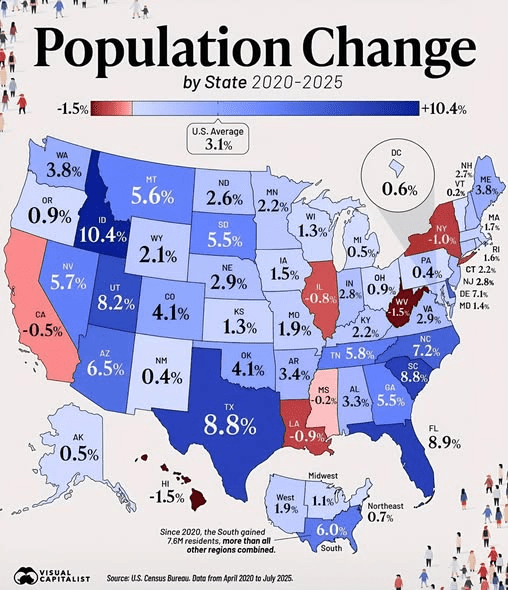
The various comments online about this of course concentrate on the (politically) red and blue State divide. And to a degree, there is a definite correlation – and indeed, direct cause and effect. That was heightened by the impact of the panic over the Beer Flu (COVID-19) in 2020 and 2021. But by no means as clear cut as many tout.
Yes, the Big Three Woke States (California, New York, and Illinois) all lost population. Note this is despite the influx of border jumpers into those States during Uncle Joe’s reign. But at the most causal observation, it is clear that many other Woke “Democratic Party stronghold” States did have population growth. Particularly note Delaware, with 7.1% but even the Great Lake States (MN, WI, and MI), Washington State, New Mexico, Colorado, and Arizona had increases. Which apparently are mostly additions to their big urban areas. Their rural and frontier areas show little growth.
So why? First off, fewer and fewer women are having children. And, if immigration really is being significantly reduced, that is a further cause of slowing or decline in population. In the past, more Regressive States (and parts of States) saw fewer and fewer children: California, Hawaii, Illinois, and New York all come to mind. But economic opportunity is also a significant factor: work, jobs, and business climate in States like Texas, Florida, and Idaho all draw people from nearby States where regulations, costs, and antipathy to business and industry create problems.
It is not, though, just a matter of politics, of “Conservative” versus “Liberal.” Living conditions, including culture, weather/climate, and opportunity (including investment) also have an impact. Each State has different factors, but when it comes to desirable places to live, work, and especially raise children, this may explain why States like Idaho, Utah, Texas, Florida, and South Carolina far outstrip everyone else.
If these numbers continue, the next decade will see the States becoming more and more disUnited, as the migration (internal and external) and the changing culture, economics, and other conditions have their impact.
A correspondent, Bob Malone, touched on this recently:
“For the first time in modern American history, we are quietly entering an era in which having children is no longer the cultural default. The United States now sits well below replacement-level fertility, and each generation, absent immigration, will be smaller than the one before it. This fact is often discussed in purely economic terms: labor shortages, aging populations, entitlement systems, and GDP projections. But fertility is not merely a statistical problem or an economic variable. It reflects how people live, marry, work, and support one another. It reflects whether young adults believe that building a family is possible, affordable, and socially valued.”
And that, in turn, impacts our daily lives, including our liberties and politics.
Think on these things?


“States like Texas, Florida, and Idaho all draw people from nearby States where regulations, costs, and antipathy to business and industry create problems.”
Usually (yes, I know that’s not you) such things are expressed with party affiliation tags, so it should be worth noting that you have to go nearly 600 miles (by air — farther by road) to get from Florida to any “non-red” state. The nearest kinda-sorta, a little bit, sometimes “blue” state is North Carolina. The nearest RELIABLY “blue” state, Illinois, is more like a thousand miles away.
LikeLike
Tom, all excellent points: it isn’t just nearby States. Of course, we also know that the States are not monoliths. I know that some people would strongly protest at calling Georgia a “red state” because of Atlanta and suburbs. Just as other folks like to argue that “It ain’t Illinois, its Chicago” and “It isn’t North Carolina, its Charlotte and Raleigh. (I do appreciate your “kinda sorta idea” of NC!) And you know our opinion of big urban cesspools. The big urban areas drive the agenda even in the States that might otherwise be red. But we should ask, is distance much of a factor for most people? For years, when Colorado was still at least “sorta” red, many Californians fled to Colorado. And of course, to Texas.
LikeLike
“is distance much of a factor for most people”
Less and less … and that’s a factor in migration and population shifts now!
Even during my lifetime and yours, decentralized peer-to-peer communiation over long distances was expensive and burdensome.
The fastest way for me to talk with you would have been to use a device mounted on a wall and pay a fairly high rate by the minute. Or we could write stuff down on paper, stick that paper in a box, and wait days or weeks for it to get to each other.
Centralized mass communication was faster due to TV, and before that radio, and before that telegraph, and before that the printing press.
But now all those forms of communication are instantaneous — and high-bandwidth enough that you or I can live in the rural south or mountain states while instantaneously communicating with — or even working “in” — Los Angeles, Mumbai, Buenos Aires, etc.
That has a lot of economic and cultural effects, both between city and the sticks and between countries.
LikeLike
Which is really neat – even though the lies and propaganda can travel just as swiftly. There may be one big challenge, though: keeping it from getting re-centralized.
LikeLike
I guess it’s the story of humanity. We discover ways to free ourselves, and those who would rule us get right to work finding ways to get us back under control.
But on the urban/rural thing, I think we’re still moving in the “ruralization” direction and will continue to do so.
More and more jobs no longer actually require people to commute to a centralized workplaces to get the job done. I was hoping that the one good effect of COVID would be to make “tele-commuting” the permanent default for those jobs, but the re-centralizers had other ideas. I don’t think they’ll be able to stop that wave, though.
Things like entertainment have largely moved from “collective physical spaces” to screens in homes. Obviously radio and TV started that trend, but it’s kept barreling along, and once again COVID gave that a boost (I don’t consider that a good effect, simply because I do like to hit a movie theater every so often — in fact, Tamara and I immediately went out and saw “Tenet,” the major film release during the “everyone stay at home, hide in your closet, and wear a mask” stuff; IIRC, there were seven people in the theater, including us).
Even in comparatively rural areas, you can get most stuff delivered these days. And soon a lot of it will probably be delivered by drones and driverless cars.
“Working population” versus “retiree population” is in decline as birth rates fall and people live longer, but productivity is increasing because we keep getting better at automation.
Fewer people, fewer of whom have to do their work at the same physical location as the others, means that not as many people HAVE to live in cities. And a lot of people won’t choose to if they don’t have to (including healthy retirees who don’t require the facilities of a “nursing home” environment).
I think that the geographical effects of “living in the country” tend to foster a different set of attitudes than living in a human sardine can.
But culturally, all of the “there are different languages, different kinds of music, different kinds of food, different religions” stuff that produce “clash of civilizations” stuff in the cities are now in the country as well. I’ll be interested to see how that plays out.
LikeLike
Tom, thanks for some great points. Makes a lot of sense, and like you say, we will all be interested to see what is coming. Much good, I think!
LikeLike