
Today is the 150th anniversary of the Greasy Grass (Pezhi Sla) Battle, officially the Battle of the Little Big Horn, and commonly known as the Custer Massacre or Custer’s Last Stand.
All of Southeastern Montana, including portions of I-90 between Sheridan, Wyoming, and Hardin, Montana, has been disrupted as thousands of people gather near Crow Agency, Montana, at the battlefield, a National Monument. (Keep in mind that the NPS website is (as usual for the NPS), a compendium of propaganda with a lot of facts but a lot of twisted interpretation. Ditto for Wikipedia.)
The battle was the climax of the Black Hills War (aka the “Great Sioux War) of 1875-1877. While it was the most significant action of that war, it was not the turning point that many think it to be. It is also important to remember that this was not the first war between the US Army and the Lakota. And not the first time that Lakota and Cheyenne had defeated the USA.
Why a war? Because gold seekers invaded the Black Hills (in 1874-5) after the public announcement of the discovery of gold by the Custer Expedition of 1874. The Black Hills (Lakota: Paha Sapa) were part of the treaty lands recognized by the US Congress in the Fort Laramie Treaty of 1851 as reserved for the Lakota, together with all of what is now West River of South Dakota, a bit of what is now North Dakota, and “unceded territory” (in essence, hunting rights) in most of Wyoming Territory and a good deal of Montana and Nebraska Territories. The treaties authorized the expedition, in part to identify military post locations to keep other Americans out of the area.
At first, the US Army tried to expel the gold miners but did not use deadly force and were therefore overwhelmed and gave up, letting miners and their suppliers flood the area. (The first settlement (where Custer found gold) was Stonewall on French Creek, later renamed Custer City. The second major camp was the infamous Deadwood Gulch, after gold was found in the Northern Hills, the Fall of 1875: by Spring of 1876 there were seven towns and 5,000 people. This was not, of course, acceptable to the seven bands (nations) of the Lakota (Teton Sioux). Following the advice of a Catholic missionary, they had kept the gold in the Pahasapa a secret for well over a half-century, including killing the entire Ezra Kind party in 1831 (while allowing a small fur-trading town, St. Onge to exist).
DC did its usual thing, and after plotting and attempting to buy the Hills, gave the Lakota a deadline to move to the various Indian agencies (east and south of the Black Hills). Of course, 31 January 1876 was the dead of winter: the Lakota could not comply even if some wanted to. So the War Department was ordered to begin military operations. The actual combat began on 17 March 1876, against a mixed Cheyenne-Lakota camp on the Powder River.
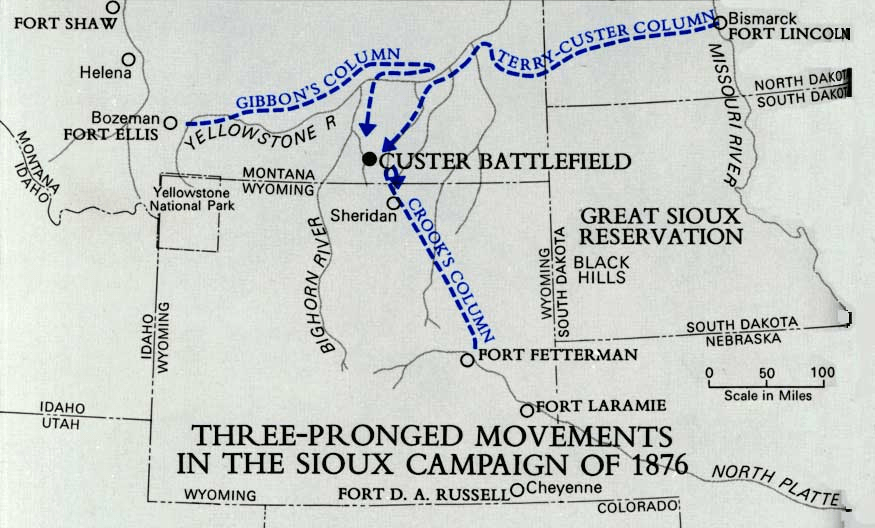
The battle on the Greasy Grass was part of a summer campaign with 2500+ US troops and allies (Crow and Arikara) in three columns trying to force an estimated seven thousand Lakota and Northern Cheyenne into reservations, fighting against about 2,000 warriors. The first significant contact was the Battle of the Rosebud, on 17 June; a narrow victory for the Lakota and Cheyenne pinned down one column. Custer and his command, the 7th US Cavalry Regiment, was detached and found the large encampment on the Little Big Horn.
Custer was a glory-hound and had been since the War between the States after graduating from West Point. He failed in many ways to properly prepare for and conduct the battle, against a force probably at least 3 times his own. As a result, 268 soldiers, all of 5 of the 7th’s companies, died on Last Stand Hill (55 WIA) of 700 men. It is estimated that less than 100 of their opponents were killed, and perhaps 160-200 wounded (including non-combatants). It was indeed a great victory for the Lakota and Cheyenne.
(It is often claimed that the Arapaho were also allies, but Lakota and Cheyenne eyewitnesses and combatants testified that only two Arapaho were involved in the battle. They were young men out hunting and actually captured by the Lakota. Although the pair did fight in the battle, they were not representatives of their nation and are reported to have accidentally killed two of the Lakota in the battle, and no US cavalrymen!)
The song Please, Mr. Custer, (Larry Verne, 1960) is played frequently each 25th of June by KINI, KILI, and other Lakota radio in the Dakotas. (It is a favorite of many of us here at TPOL.) And it is a national holiday for at least some of the Lakota Oyate (nations).
The battle was actually fought on Crow territory, and today remains a part of the Crow Reservation: it is seldom stated that the Lakota and Cheyenne were trespassers, whom the Crow wanted expelled.
The victory on 25 June did not end the war. Some Lakota panicked; while many did surrender at the various agencies, some fled to Canada. Additional US troops were deployed and rounded up the “hostiles in 1876 and 1877.” Congress played its usual games, and among other disasters, the Northern Cheyenne were forced to move to Oklahoma to join the Southern Cheyenne. (They later escaped and returned north to Montana, where their descendants are today.) Congress passed the Agreement of 1877 exploiting the victory by US and allied forces, taking the Black Hills from the Lakota (as they had earlier in 1776 taken it away from the Cheyenne) by conquest.
The cause of the war, the battle, and the results are perfect examples of two things. First, people will fight for their freedom and their people and land. Second, government does very stupid things. While upholding US treaties with Crow and Arikara, Congress treated Lakota very badly.
It is a lesson we must learn.


