
Today is the 251st anniversary of the promotion of Nathanael Greene to Brigadier General in the military forces of Rhode Island. The date was 8 May, 1775.
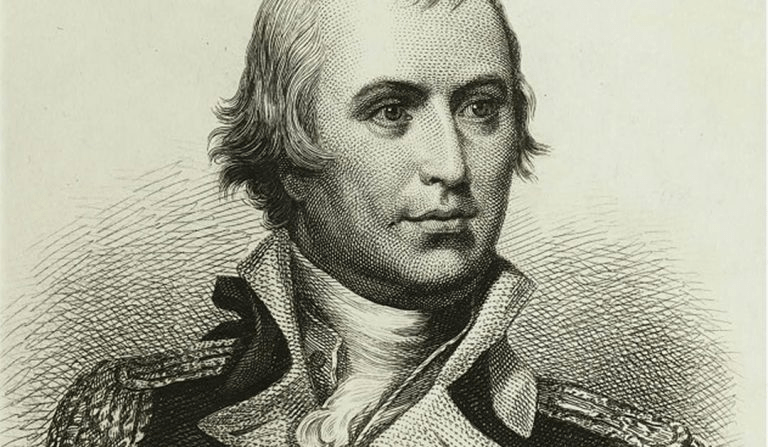
His example is worthy of emulation, and a reminder that talent often comes from totally unexpected directions.
On 20 April 1775, Nathanael Greene literally took his first steps toward becoming one of the greatest generals of the American War of Independence.
At his home in Coventry, Rhode Island, he received news of the shots fired in Lexington and Concord, Massachusetts the day before.
He had already helped form a militia company, the Kentish Guards. That worthy organization (volunteer and without pay, please note) served East Greenwich, Warwick, and Coventry, all in the relatively new Kent County (organized in 1750 from part of Providence County). The company-sized unit was formed on 24 September 1774, and chartered by the Colonial Assembly on 29 October of that year. The impetus was to provide defense of the towns against Tory (loyalist) mobs such as the one that had attacked East Greenwich and attempted to loot and burn the town.
The unit mustered and set out for Boston.
Though he had helped organize the militia unit, Nathanael was just a private in the Kentish Guards. He had previously applied for lieutenant and was denied because of his limp: he was (in modern terms) handicapped or disabled.
When they passed through Providence (capital of the Colony (Province) of Rhode Island and Providence Plantations), , teenager John Howland, who would go on to fight in the Revolutionary War, remarked: “I viewed the company as they marched up the street and observed Nathanael Greene with his musket on his shoulder, in the ranks, as a private. I distinguished Mr. Greene whom I had frequently seen, by the motion of his shoulder in the march, as one of his legs was shorter than the other.”
Although Rhode Island had started protesting against the King’s government as early as 1772, at this time, the Rhode Island governor was a British loyalist. Joseph Wanton recalled the Kentish Guard at the border. So Nathanael returned home.
Then he was gone again, this time to Providence to attend an emergency session of the General Assembly on 22 April 1775. Nathanael was one of many who sat on committees to authorize and organize a Rhode Island army of 1,500 men called the Army of Observation. They would cooperate with similar forces from other New England colonies for the common defense of the provinces, quickly forming the New England Army of 20,000 troops.
The Army of Observations needed a general to lead it. They chose Nathanael Greene and commissioned him a provincial brigadier general on 8 May 1775. He became one of the deputy commander of the entire New England Army.
Imagine that: A private in September of 1774 and a brigadier general in May of 1775. Not even Generals Grant, Custer, or Pershing can claim such a rapid sequence of promotion.
He would go on, in the War for Independence, to become the “Savior of the South” as part of the Continental Army. Together with General Daniel Morgan, he led the troops that harried and pushed British General George Cornwallis to Yorktown in Virginia. Where Cornwallis surrendered to General Washington’s American and French forces in 1781. Even today, he is considered a more skilled, more brilliant general than Washington himself.
Not bad for a man born “crippled” with a short leg in a time when prosthetics (when available) were carved by hand from a piece of wood. And who, though a New Englander born and bred, still bonded with and led to victory all those rebellious, jailbait Southerners.


