
And
And…
And
And…
A friend shared this from an unknown author.
Checking out at the store, the young cashier suggested to the much older lady that she should bring her own grocery bags, because plastic bags are not good for the environment,.
The woman apologized to the young girl and explained, “We didn’t have this ‘green thing’ back in my earlier days.”
The young clerk responded, “That’s our problem today. Your generation did not care enough to save our environment for future generations.”
The older lady said that she was right, our generation didn’t have the “green thing” in its day. The older lady went on to explain: Back then, we returned milk bottles, soda bottles and beer bottles to the store. The store sent them back to the plant to be washed and sterilized and refilled, so it could reuse the same bottles over and over. So they really were recycled. We used old newspapers to line birdcages.
As we here at TPOL have been researching and writing commentary the last several days, an interesting question (or group of questions) came up.
The first regards Dr. Faucet (we know, his name is really Fauci – but this isn’t a typo.)
We can now be fairly certain that he funneled money to China, and in particular to the Wuhan laboratories, to support research on “gain of function” for various viruses. Including the infamous and historic SARS-CoV2 virus which was released from that lab and is the cause of COVID-19. (What we generally call “Beer Flu” in derision: not that it hasn’t killed people, but to remind us of how this fiasco has impacted us.)
The GAO tells us that the NIH and other related agencies gave grants of 3.7 million dollars (US-FRNs) between 2014 and 2019 to the Wuhan Institute of Virology. During that five-year period, a total of 28.9 million dollars went from DHS (and presumably other FedGov agencies) directly to Chinese entities, supposedly for research.
Now, 3.7 or 28.9 million is a drop in the bucket for Uncle Sam’s burning pockets in the days of trillion FRN deficits and a national debt approaching $40 trillion.
But why? Why is the FedGov sending ANY money (grants or not) to China and therefore directly or indirectly to the Chinese Communist Party?
Continue readingReaders know that TPOL has a rather low opinion of Her Imperial Highness, Michelle Lujan Grisham, overlord (governor) of New Mexico. Her reign has done possibly irreparable damage to the people, land, economy, and environment of the State of New Mexico. And certainly more than any previous governor or government of New Mexico. (New Mexico, unlike the other American States, is more than 400 years old, having been established in 1598.)
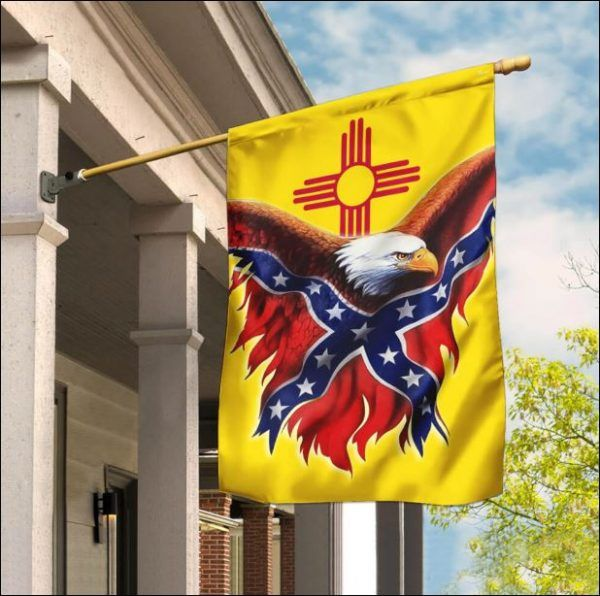
But today, we might give – might! – at least a qualified thumbs-up to the Empress of New Mexico. As reported several places including KOB of Albuqueque, she is trying to get the legislature to kick ICE out of the State of New Mexico.
Wow. Imagine the guts it takes for a pitiful little State like New Mexico to tell big bad Uncle Sam “go away,” we don’t want you here.
Continue readingOne of the many recent (21 July 2025) revelations from the FedGov’s Department of Health and Human Services (HHS) reveals yet another evil way in which the FedGov (and State and local governments and Big Pharma and other Big Business) treat humans from conception to death (and their castoffs beyond that!). We know many medical care providers understand and practice good medical ethics. But that is not the case among government and “private” entities that control the systems. Once again, RFK Jr. has delivered a blow against the medical establishment. This one strikes at the very heart of morality.
“Our findings show that hospitals allowed the organ procurement process to begin when patients showed signs of life, and this is horrifying,” Kennedy said. “The organ procurement organizations that coordinate access to transplants will be held accountable. The entire system must be fixed to ensure that every potential donor’s life is treated with the sanctity it deserves.”
The tone of this DHS announcement and many of the commenters, (both “public servants,” including elected officials, and many “independent” observers) is “reassuring.” It was misguided zeal (to save lives) and benign, unintentional negligence, they say. The attitude seems to be, “Now that they realize what was wrong, we will fix the system.”
Hogwash.
We have deliberately planned and implemented evil. It degrades western civilization, divorcing society and its institutions still more from the biblical values and morality on which it was (at least partially) built. It takes away voluntary consent, individual dignity (honor, to use an old-fashioned term), and respect for the human body.
Why? Obviously, for many, profit is the motive. Unencumbered by questions of ethics, morality, or human rights. But we submit it is more: it is a deliberate, callous, planned effort to destroy society and therefore our nations, as part of the effort to replace them with something. Something, in our eyes, evil, monstrous.
Continue readingOne principle of environmental science and engineering is that air and water pollution are a form of trespass. When you intentionally or accidentally allow contaminants in the air or water that leaves your property to cross into someone else’s property. You are committing a trespass, and can be held legally liable for the consequences. Just like you could if your dog pooped on the neighbor’s lawn, or that same dog pulled over your trash can and scattered trash into the street and your neighbor’s yards.
US (and international) law even goes so far as to say you are trespassing if that happens not because you intentionally or accidentally released the pollutants, but if you fail to take action to prevent those contaminants from going into the air or water (both surface and groundwater). Of course, a government agency with jurisdiction can issue you a permit that allows you to pollute your neighbor’s air and water – or even that of folks miles away from you – if you pay your fee, obey their draconian orders, and are nice to the inspectors and other officials.
(It’s a wonderful scheme to increase government power, isn’t it?)
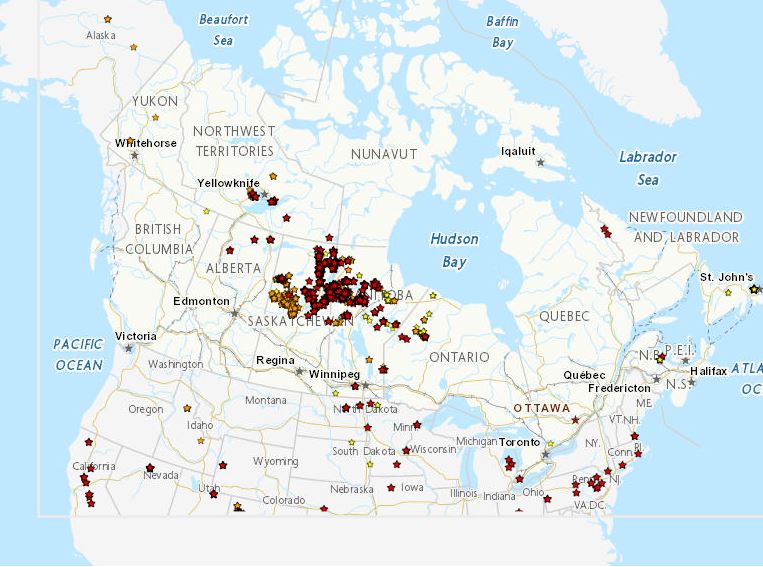
Now, let us look at August 2025 and the Dominion of Canada. In fact, here is a map:
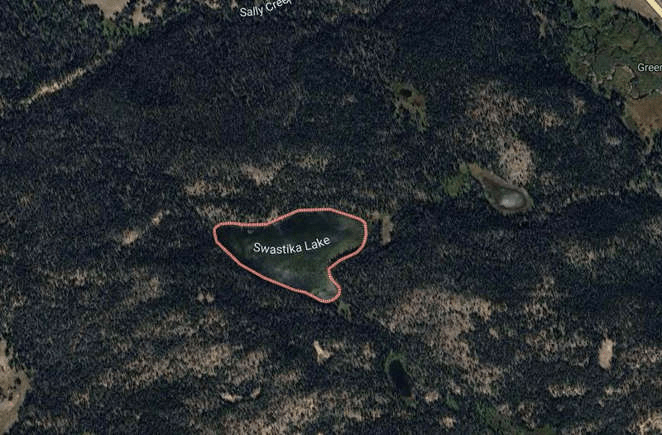
Once a quiet alpine lake hidden in Wyoming’s rugged backcountry west of Laramie, “Swastika Lake” is now at the center of a heated national debate. While its recent name change was supposed to address the symbol’s disturbing modern associations, many people are not happy—and tourists should pay attention. Here are some reasons this scenic spot is making headlines:
Continue readingThis is a guest commentary written by a beloved friend and brother of the TPOL community. It is just as applicable today as it was four years ago. [TPOL editor comments in brackets.]
The Trained Marxist…
Authoritarianism is the belief that people must obey the government completely and not be allowed freedom to act as they wish. Authoritarianism is opposed to individual freedom of thought and action. Authoritarian governments rule via mandates and compliance to state or political party desires and dictates. It is a government absent of bipartisan involvement.
These dictatorial forms of government will concentrate their power with a certain political or critical theory of rule.
Continue readingGrowing up in the 1950s and 1960s, American media was dominated by the Big Three television networks, and a few national magazines.
ABC, NBC, and CBS are still with us. Most of the old national magazines are gone or bizarrely changed into odd parodies of their original incarnation: Time, Life, Newsweek, US News and World Report, Saturday Evening Post, and a few others. Some would add Grit, The New Yorker, National Geographic, and even Playboy. One major one, though, was Reader’s Digest.
(We realize that younger readers may not recognize many of these.)
All these magazines had a very profound impact on American culture, society, and politics in the quarter-century after World War Two. It is claimed that they influenced public opinion and policy, and that they “reflected the cultural and social changes” of the era. The reality seems to be darker: yes, they influenced opinion and policy, but the publications actually created many (or most) of the changes in society and culture.
For most values of liberty and freedom, many changes were for the worse. And for bad, not good, a lot of what these hardcopy publications (with circulation numbers in the millions) was false. Lies and twisted truth that pushed those changes.
Continue reading The Price of Liberty
As Trump’s troops and cops clean up DC, here is what is happening to the homeless
Or so the Western Journal says.
It was supposed to happen in 2022, but hey! COVID-19 delayed lots of things!
But seriously, what the 1600 PA spokescritter said was not this. Rather: Leavitt explained that police officers will give the homeless the opportunity to leave the encampment, be taken to a homeless shelter, and be offered addiction or mental health services. “If they refuse, they will be susceptible to fines or to jail time. These are pre-existing laws that are already on the books. They have not been enforced,” the press secretary reiterated.
Assuming she isn’t just using some euphemisms, or playing the same games that Harry Harrison wrote about in “Make Room! Make Room!” (The novel the book was based on.)
But it is not the homeless in DC (or any American city) that are the real threat to the peace, prosperity, and sanity of the community.
The homeless on the streets and sidewalks, under bridges and underpasses, in alleys and doorways and parks and parking lots are the results of the real danger facing American cities. And all of the States.
That real danger can be seen in many forms.
Politicians who don’t care for anything but votes, paychecks, power and wealth.
Voters who can be cozened by those politicians.
A lack of love and caring for one another: not just your family (immediate or extended) but people who need help: not just handouts but people helping them to get over or mitigate their mental illnesses, their hopelessness, and their addictions. Including parents who did not raise up their children in a moral and ethical and loving way.
Which boils down to a lack of personal responsibility. People who want to let “George do it” – and George usually means DC or their Statehouse or City Hall. Which are filled with people who have no personal responsibility. No real love except (maybe) their own families and kind. And who are willing to throw billions of dollars of YOUR money (never their own) to supposedly provide care and love to people who need it.
If The Donald really wants to clean DC up for the 250th birthday of these United States, he’d do a lot better to start cleaning up the politicians, the lawyers, the judges, and the bureaucrats, while explaining to the voters, “you surrendered everything to these people.” (We expect he’d use more colorful language.) Of course, those won’t make good Soylent Green either: polluted minds and bodies and corrupt souls are poison. Maybe we could used them for retaining walls or something.
In other words, as the bogus ad above says, “it’s our people that make the difference.”