Welcome to one of the Socialist States of America.
Ruled by Her Imperial Majesty, Michelle (I) Lujan Grisham, since 2019, the State has increasingly become both more socialist and returned more to its origin and roots as a (now-“independent”) province of Imperial Spain. It is a curious mix of bizarre sects and “alternative lifestyles” and traditional Spanish, AmerInd culture, and high-tech. It is both poor and expensive to live in.
One of the most recent examples is the “Universal Child Care” plan pushed by HIMajesty and gladly accepted by the State’s Woke legislature. Every child in the State will now be entitled to receive free childcare, both preschool and apparently before and after school hours.
The following commentary is the work of a friend of The Price of Liberty, Donald. TPOL has added a few comments here and there in brackets and edited for clarity!
Why learn about fascism? Whether it is Italian or Spanish or Argentine style (or even the German National Socialist variant), it is an enemy of liberty. We need to recognize it and encourage people to stop mislabeling anything and anyone that they don’t like as fascists or Nazis. And especially to examine those people whom they do like to see if perhaps they are exhibiting indications of fascism (belief and behavior).
——————-
– I have been asked to write an article about Fascism in the USA, and so I am.
— In my background, I have had detailed discussions with people who have lived under both Soviet Communism of the USSR and Fascism under the Nazi state during WWII. In my interviews with these people living under both systems, they all stated there was no difference in leadership. Both were repressive and controlling.
The ether is filled with stories of how people were foolish enough to trust the various pieces of software and the data stored on immense servers when it comes to daily activities.
When the weaknesses of AI combine with the wonders of information technology, and Murphy’s Laws, life, limb, and liberty are at stake. We all remember (and shudder) the Blue Screen of Death (yes, it has an acronym: BSOD).
Many are funny (at least if you are not the victim of the falsely placed trust).
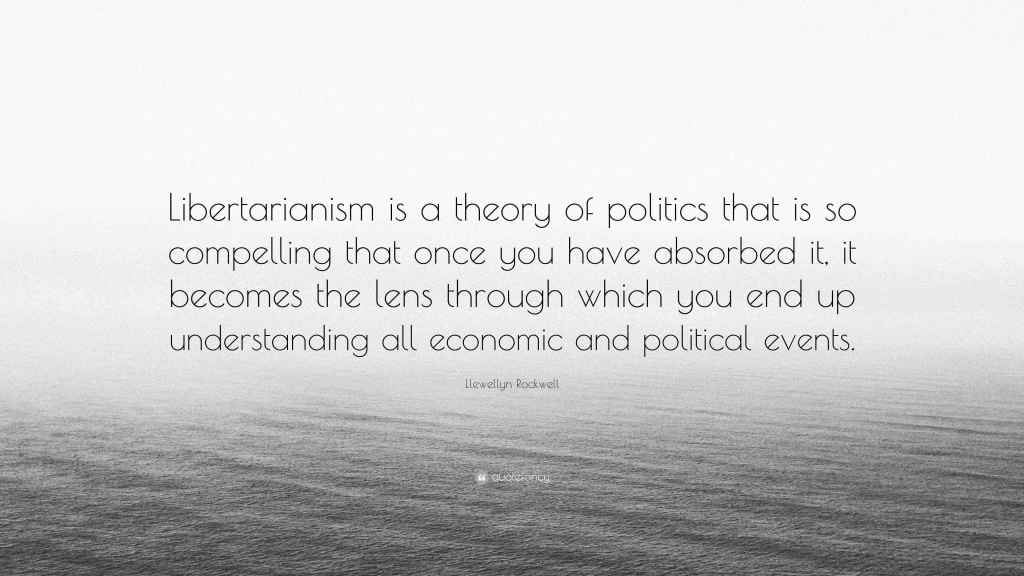
Lew Rockwell once posed an interesting observation:
The Price of Liberty very much believes that Lew’s observation is not just correct, but is something that all lovers of liberty should understand and apply.
We here at TPOL attempt to apply this principle. We are, as we sometimes note, libertarians (lovers of liberty) because we are first christians. That is, followers of Jesus the Christ; we see “extreme libertarian” anarchism and free markets as the only political and economic philosophy that is truly compatible with the New Testament. We see human liberty (both personal and economic) as a gift from our Creator.
(We do not condemn nor reject those who are lovers of liberty who are not believers – we just believe that they are wrong, and encourage them to examine themselves and the universe carefully.)
Our worldview, therefore, is based on the Bible and on the economic and political theory of libertarianism. The heart of true biblical christianity is love: God is love, and we are to love Him and to love our neighbors as ourselves. This in turn leads to what is called the Golden Rule, as stated by Jesus: “do unto others as you would have them do unto you.” Politically and economically, and socially, this is expressed in the Zero Aggression Principle: individuals should not initiate force against others. That is, aggression against others or their property. We see such actions as sinful and illegitimate.
We are, at best, small-mouthed pacifists (as described by Heinlein and others). We believe, again as given by God, humans have the right to use force for defensive actions only: of ourselves and others. (We do not have to always use force: that is our choice. We have free will (another gift of God) to decide whether to respond or to turn the other cheek.
This is, of course, why we reject human, mandatory government. Not only is it in rebellion to God, not only does it fail to meet the most simple of standards, but claims the “right” to initiate force, to aggress against people.
We ask our readers not just to ask themselves what their worldview is, and whether or not we act in conformity to our worldview. We ask them (and ourselves) to ask those around them, those they come in contact with, how those people view the world and how they apply that view.
And give thanks to God, to readers, to friends, and to correspondents, for their understanding, encouragement, and more. We love you and pray for you.
Nathan, Debby, Gareth, Andrea, Matthias, Kaylynn, all the little ones, all the cats, and all the snakes and lizards!
Socialism has been a system tried frequently in American history, or so even the “progressive” history books tell us. The general evidence of history is that the overt attempts to force such a system have failed. Tragically.
It being Thanksgiving Day 2025, we can look at one of the earlier attempts, that of the Pilgrims of New England in 1620 and following years. Called the “common course,” those who fled religious persecution and sought opportunity in the new Plymouth colony tried socialism in what would be recognized as almost classic Marxism two centuries later. It failed, and as a result, many died. And it was abandoned. Richard Ebeling writes an excellent article about it at the Future of Freedom Foundation.
AmerInd nations, at various times and locations, tried it on their own. And for more than one and a half centuries, the FedGov (courtesy of the BIA and IHS) have imposed a version of socialism on the various reservations, under the guise of “treaty rights.” Objective observers conclude it has failed.
Various religious communities and sects have also implemented socialist schemes in communes and through other efforts and locations. Few of those survived even a few years; those that have survived and even thrived did so by abandoning the fundamentals of socialism.
In 2025, the election of various self-proclaimed socialists and communists, and the continued presence of the same in Congress, many State legislatures, and even more local government councils alarms many people.
By the time this is published online, we here at The Price of Liberty assume that you’ve already celebrated the day. Hopefully with family and close friends and neighbors, and hopefully without too much stuffing of yourselves with food and drink! And have enjoyed the company and conversation and other activities.
For lovers of liberty, every year, there are many things to be thankful for. Whatever threats, whatever actions that governments and their supporters and advocates have taken in the past year, we still can be thankful for the liberty we do have.
The organization currently known as “Scouting America” (formerly the Boy Scouts of America) is a perverted and corrupt version of what it was created to be and how it existed for decades. It is a classic example of how human institutions decay over time.
The latest episode in the saga of the former BSA is in the news today.
The Pentagon is reportedly preparing to end a century-old partnership with Scouting America, formerly known as the Boy Scouts. Defense (War) Secretary Pete Hegseth has drafted a memo to Congress criticizing the organization as “genderless,” claiming it no longer supports “the future of American boys” and accusing it of abandoning meritocracy in favor of diversity, equity, and inclusion (DEI) initiatives. The Pentagon’s support for the Scouts, started just a few years after the Boy Scouts came to American shores, was formalized in 1937, has included medical and logistical assistance for the National Jamboree and allowing Scout troops to meet on military bases worldwide. The military forces offered expedited promotions for Scouts who achieved certain ranks, and actively recruited Scouts in all branches. Individual installations and units provided a wide variety of support for the troops, packs, posts, and councils of the BSA, coordinating millions of manhours of volunteer work by serving military and DoD civilians, in-kind donations of equipment and supplies, and use of military facilities.
Everyone knows that guns are verboten in Canada. Along with saying anything that might be viewed as negative towards homosexuals, transgenders, or Muslims. But as with any Animal Farm society, some animals are more equal than others. A few weeks ago, several “professional marksmen” used guns to kill almost 400 ostriches. You see, enforcers of a despotism are exempt from gun prohibitions. The hay bales made it a “turkey shoot” – the birds were sitting ducks. (Puns intended)
Western civilization is in danger of a “Final Collapse.” Like cultures, civilizations, societies, nations, and empires before us in the planet’s history, collapse is inevitable. Maybe slowly, maybe much faster than expected or even realized. Even keen observers may not realize it has happened for decades.
Thirteen elements are the foundation of western civilization, though no one has achieved perfection in them. It has survived for more than 500 years. These elements are threatened. We (and others) believe the likelihood of Final Collapse in the next few years is high.
Free thought: Today, the Orwellian concept of thought crime is replacing the idea that people should be taught and allowed to form their own opinions, understandings, and beliefs. (And act on those beliefs as long as they did not harm or threaten to harm others: physically harm, not “offend” or “scare” others.)
Free speech: Many today reject defending others’ right to speak even though you disagree with them, and deny the right to hear (and responsibility to listen to) opinions and ideas you find distasteful.
Free markets: It is dark humor to call today’s system “free markets” when every economic activity is tightly regulated, virtually all licensed, and milked for every mil by taxes, fees, and fines. It is not just a push into more and more socialism, it is increasingly separating “ownership” from control.
Limited government: As TPOL has pointed out recently, governments at all levels have rejected and ignored limits on their powers, grasping constantly for more and more. Even those who loudly protest and claim that limited government is essential strive constantly to gain more control for governments.
Individualism (versus group identity): Society and governments more and more push for “cookie-cutter” personalities. Oh, yes, we have subcultures and counter-culture thinking and behavior, but such activities just make us part of a group, to be coddled and recruited by politicians and political leaders – and corporations (as customers/consumers and employees). Anyone who is a square peg in a round hole is forcibly trimmed to fit. Even if they are destroyed.
Rationality, including science, logic, and fact (not superstition). Groupthink replaces all of this: consensus supersedes understanding of natural processes and humans. These fundamental ways of viewing the universe and ourselves are rejected as racist, elitist, and demeaning to others.
Liberty is seen as a danger. Snowflakes need shelter in safe spaces for fear of being triggered. Unconstrained people free to do what they want, are viewed as evil to be feared and destroyed or kept away from others.
Progress. The West’s always strived to make progress: to improve our own condition and that of others. Even when efforts to make progress in medicine, science, technology, agriculture, and politics were misguided, it was a laudable goal. No longer: progress is feared even more than Luddites did, because it will change lives and potentially impact those who are disadvantaged and disabled.
Privacy. “Mind your own business” is no longer a watchword for more and more of society. Everything must be known: transparency is mandatory. We are pushed into the Chinese Social Credit model. Not just free thinking, but anything which is outside the norm for your assigned group in society, must be suppressed.
Property Rights: Nothing belongs to you: certainly not land, resources, or for that matter, your own time, labor, and body. “Society” (government), and disadvantaged groups can call on you to provide any and all of these for their benefit at any time.
Rule of Law. Even in most of the monarchies of Europe in the 1500s and 1600s, this was an essential element of life and society. But even the most tyrannical and absolute of monarchs, dukes, counts, bishops and the like did not attempt to micro-manage the daily and hourly activities of their subjects (even their serfs and slaves) the way modern “democratic” governments at all levels do. And today, perhaps even more than back in the early days of western civilization, “who you know” and not what you know or what the laws are seems to be a crushing burden on the common people and ordinary businesses. Regulatory abuse is far greater with wicked judges than with honest ones.
Industry and private enterprise: Like free speech and progress, today industry (in both the sense of manufacturing and the idea of working hard for specific objectives) is viewed as unacceptable and against the interests and wishes of the people. (By the politically-correct enemies of liberty and wannabe rulers.) Private enterprise (true capitalism, like free markets) is intolerable: all must bend the knee to the Woke.
A biblical understanding of morality: we understand that some lovers of liberty may find this odd. But most nonbelievers in deity and at least some people of other faiths (Muslims, Hindu, etc.) understand the basics: the sanctity of human life, the Golden Rule (Zero Aggression Prinicple), the need to balance liberty with responsibility, even the need to love one another. Today, in addition to sexual immorality and destruction of the family by governments and individuals, we see a breakdown in morality in both public and private lives. Especially dealing with honesty, a work ethic, and immorally dealing with the above twelve items. The elements that bind society together and insulate against both inside and outside have or are failing.
All these foundational principles are challenged today in many ways. The solutions to these are simple but difficult to complete. We must teach these fundamentals, we must provide examples of doing so to those around us, and we must help ourselves and other accountable.
Playing the games of those who seek destruction will fail: civilization will fall. If we push back and struggle for these ideals boldly, civilization may still fall, but a new and better one will arise.
Editor’s note: we continue to be on a limited schedule due to travel and work. Please bear with us!
As anarchists, we here at The Price of Liberty are opposed to any and all mandatory human government. From a “one-world” or transnational state and government to a local “homeowners’ association” or special services district. (Yes, most homeowners’ associations are de facto governments.)
But even so, we understand that limited mandatory human government is far more preferable, far better, than what most of us (and most of mankind) have endured and endure today.
There were multiple times in history when men have attempted to create and sustain limited government. This is little more than tolerating something that is inherently intolerable. Many ways have been sought and tried to limit the power of government, to prevent the rise of the all-powerful state. However, humans are perversely ingenious and are inventive when it comes to enslaving their fellows. And in convincing the slaves that they are still free.






New Mexico -home of the fee, land of the rave(ing mad)
Welcome to one of the Socialist States of America.
Ruled by Her Imperial Majesty, Michelle (I) Lujan Grisham, since 2019, the State has increasingly become both more socialist and returned more to its origin and roots as a (now-“independent”) province of Imperial Spain. It is a curious mix of bizarre sects and “alternative lifestyles” and traditional Spanish, AmerInd culture, and high-tech. It is both poor and expensive to live in.
One of the most recent examples is the “Universal Child Care” plan pushed by HIMajesty and gladly accepted by the State’s Woke legislature. Every child in the State will now be entitled to receive free childcare, both preschool and apparently before and after school hours.
Continue reading →