
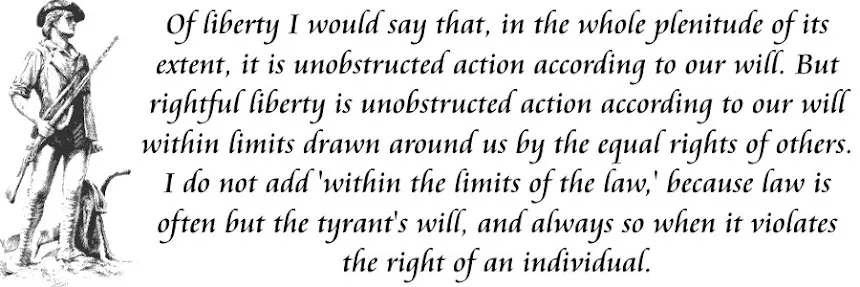
Thomas Jefferson wrote this in a letter to Isaac H. Tiffany on April 4, 1819, explicitly noting that he did not add “within the limits of the law” because “law is often but the tyrant’s will, and always so when it violates the right of an individual.” It is an important distinction.
There in lies the difference between a truly libertarian mindset and a libertine attitude and life.
Today, that has been recognized (as probably Jefferson and others of the Founding Fathers (and certainly, Mothers!) understood) as a form of restating of Jesus’ Golden Rule. “Do unto others as thou would have them do unto you.” And distilled into the Non-Aggression or Zero Aggression Principle.
Of course, Jefferson et al. understood that the People themselves (en masse or a majority) could be “the tyrant” and so chose a republic rather than a democracy. A choice proven wise just a few years later in the bloody chaos and tyranny of the French Revolution and decades of horror.
Often, we must describe liberty in negative terms; what it is NOT. Jefferson did this, as he neared the end of his life. By “tyrant’s will,” President Tom meant laws enacted by a government that violate the inherent, equal rights of an individual.
He argued three key points:
- Law is not inherently just: He refused to define liberty as action “within the limits of the law” because legislation does not automatically equate to morality or right. Human law is just that: human and therefore flawed. It is always, to some degree, rebellion against God and the natural order.
- The Definition of Tyranny: Any law that infringes upon an individual’s natural rights ceases to be a legitimate exercise of authority and instead becomes an act of tyranny, regardless of whether it was passed by a legislature or a monarch. Whether passed by a majority or a plurality. Whether a local action (such as a homeowners’ association or a electric cooperative) or a federal or international action.
- Supremacy of Natural (God-given) Rights: For Jefferson, the “equal rights of others” were the only legitimate boundary on freedom; any legal boundary exceeding this limit was merely the will of a tyrant imposed under the guise of law. These laws took away our liberty, and our responsibility and accountability to ourselves, others, and our Creator.
The tyrant, whether a single person or a majority (and anything in between) seeks to take and use the power which rightly belongs only to our Creator.
Time and time again throughout 6000 years of human history, we have seen tyrants rise to power, claiming either they have God’s (or a god’s) blessing or that they are indeed a god themselves. And time and time again, lovers of liberty have been forced to defend themselves and others against the tyrant. If they did not love and aim for liberty, they generally failed, bringing little more than a period of chaos before a new tyrant rose up. Again following a footworn vicious circle, ignoring the lessons of history, and at great cost.
People do not, often will not, understand what Liberty is, what it means, and what it requires of us. It is usually a high price paid for liberty. (Hence the name of this ‘zine.) Nor is it a one-time cost, at least not beyond the lifetime of a single human who loves liberty.
Think on these things!


