
As we see “Awfully Ignorant” (seriously, how can AI really stand for “Artificial Intelligence” with a straight face?) exploding across the States and the planet, things continue to get strange.
The entire AI craziness is, we believe, directly tied to the entire Data Center controversy. Whether the opposition to massive data centers is being pushed (or at least triggered) by the CCP (or Russia, or the Iranians, or “just” Soros and Bill Gates) or is the latest tactic by the Woke, environists, and Luddites, it is clearly now a significant issue in thousands of communities. As well as an incredible display of cognitive or mental dissonance. You use AI, you use your smart phone, you spend all your time on social media and streaming movies and television series, but you are totally against the infrastructure and consumption of power and water necessary to furnish you those wonderful things.
Of course, this is again (as with so many things) not new. Here is a great example of how people can completely miss the obvious and behave stupidly. It applies to government, private business, and every other part of society.
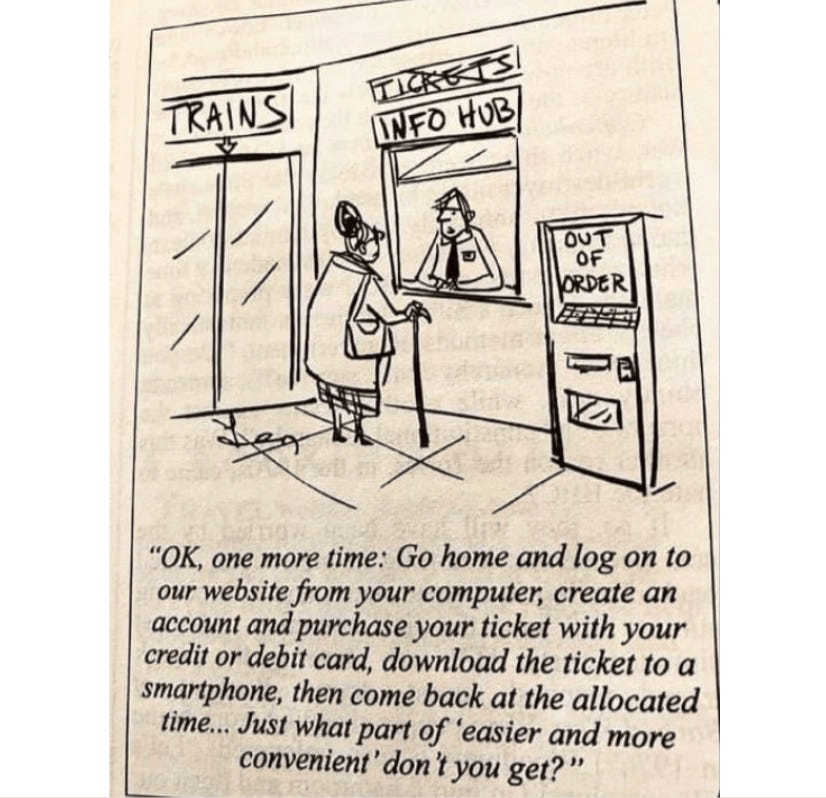
Remember that today, there are virtually no privately-run passenger railroads. (And those that are private are pretty much tourist lines that really don’t go anyplace for real, like the Black Hills’ beloved 1880 Train or the Silverton & Durango in the Four Corners.)
Continue reading




Media, American style: The Donald and AI
A correspondent shared some images and memes with us here at TPOL, worth sharing.
We note this is generally addressed to “mainstream media” but similar ideas (that is, lies) can be found in alternative media.
And of course, “trust us when we say that AI is going to kill off all of humanity: maybe not in just 10 years, but certainly some time in the future. (Gee, maybe they learned from all the prophecies which made Algor a false prophet.)
So we have this:
But just as a reminder of Algor and such (many blasts from the past!):
Blood, violence, fear, and panic all sell papers, magazines, and get clicks. It has been the case almost since printing and newspapers were invented. It is no different in the age of social media and online publication.
But there are also more motives, both in the past and today. Whether we are talking the patriots of Boston in pre-Independence times, rabid Radical Republicans in the years leading up to the War between the States, yellow journalism and the Cuba question, or so many more, there are ulterior motives to these claims.
The point has been made by a number of commentators, including people in all parts of the political diamond. In recent days, the return of “Commie Kammie” (Harris) to the campaign road illustrates that the lust for power, and therefore the need to dominate and control elections, drive much of the rhetoric and the fearmongering and panic-incitement regarding both Trump and the AI controversy and panic. Add to that the constant need to expand the powers of governments at all levels, and it becomes clearer.
Every year, especially every election year, we see yet another crisis and panic. At least a main one: there are often more than one. And both wings of the Old Party are responsible. Whether this is a planned and coordinate effort (as some claim) or just the result of unhealthy and often fake competition and role playing, it is bad for liberty. Bad for the States, and bad for the world.
PS: It is not that we necessarily disagree that The Donald is a threat to democracy (or even to the republic and liberty). We just don’t see him as any greater threat to our nations, liberty, freedom, and many other good things than, oh, Biden, Obama, Bush II, Clinton, and on back. (We might give Silent Cal (Coolidge) a pass. Maybe.)